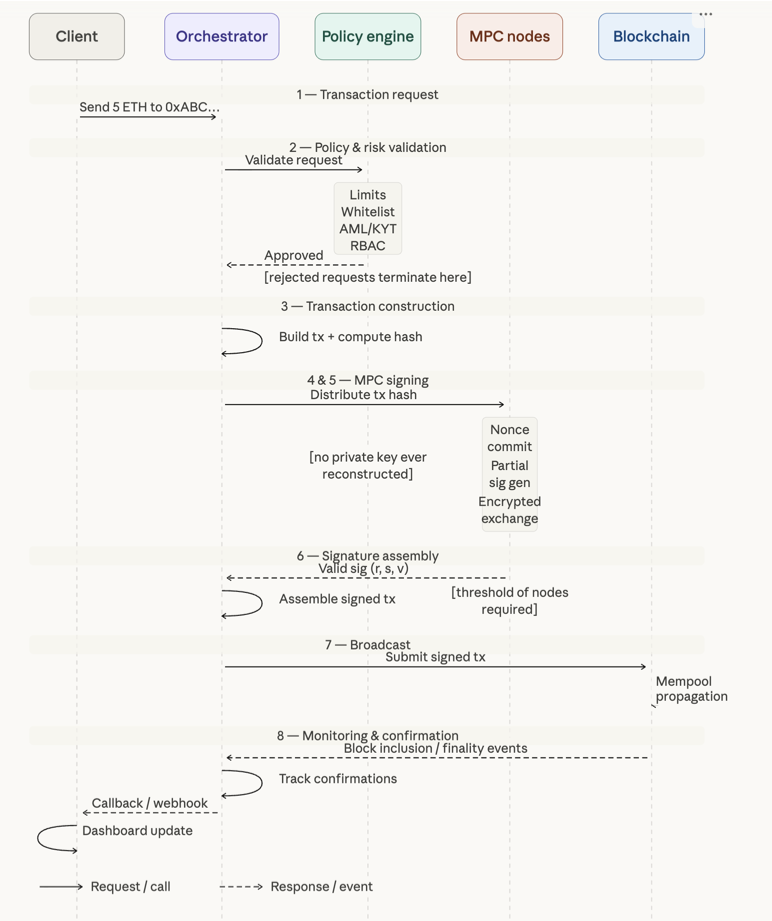
Finrock’s MPC (Multi-Party Computation) wallet architecture enables secure management of digital assets without ever creating or storing a full private key in a single location.
Instead of generating a traditional private key, the system creates multiple cryptographic key shares distributed across independent signing nodes. These shares collaborate through a secure MPC protocol to generate valid blockchain signatures without reconstructing the private key at any point.
This design significantly reduces single-point-of-failure risks while enabling institutional-grade wallet infrastructure for businesses managing digital assets.
Cryptographic Foundation
Finrock MPC wallets are based on threshold cryptography, where a private key is mathematically split into multiple shares.
Common configurations include:
- 2-of-3 MPC
- 3-of-5 MPC
- custom enterprise thresholds
Only the required number of participating nodes can jointly produce a valid digital signature.
Key cryptographic algorithms supported include:
- ECDSA (secp256k1) – used by Bitcoin, Ethereum and most EVM chains
- EdDSA (Ed25519) – used by chains such as Solana
Key generation is performed using Distributed Key Generation (DKG) protocols so that the full private key never exists during creation or operation.
MPC Node Architecture
Each wallet consists of independent signing nodes, typically deployed across separate infrastructure environments. Each node stores only a cryptographic share of the key, making it computationally infeasible to reconstruct the private key unless the MPC threshold is met.
Example deployment:
- Node A - Resides in a VM with AWS/Azure. [Application server environment]
- Node B - Resides in the Finrock Mobile app. [User Controlled]
- Node C – Backup signing node or disaster recovery environment
Nodes communicate through secure encrypted P2P channels during signing operations.
Transaction Signing Workflow